

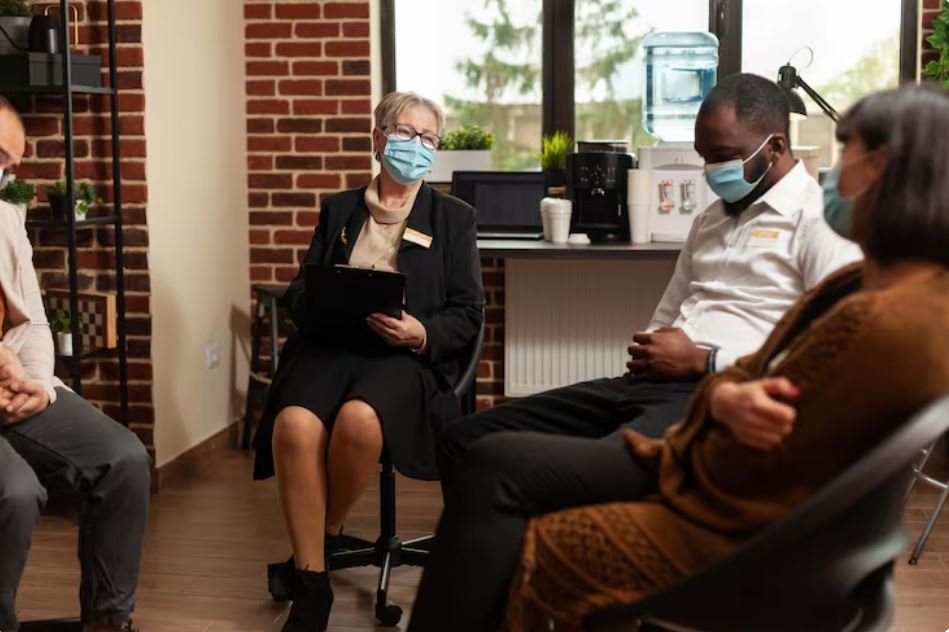
From the outside, it doesn’t appear to be a revolution. This tiny clinic has undergone a remarkable metamorphosis despite having a faded blue sign, a small doorway, and a waiting area with mismatched chairs. It is subtly changing how mental health care can be provided to people worldwide by fusing technology, empathy, and local knowledge.
Beneath the surface of conventional therapy, a digital rhythm hums. Patients track their sleep, mood, and activity patterns using the mindLAMP app, which was created at Beth Israel Deaconess Medical Center. This helps therapists gain a better understanding of their patients’ everyday lives. Through a dynamic feedback loop that keeps therapy responsive rather than reactive, this data-driven approach enables clinicians to customize treatment in real time.
| Focus Area | Description |
|---|---|
| Core Innovation | Integration of digital tools, mobile clinics, and community engagement to widen access to mental health services. |
| Influential Models | The Digital Clinic at Beth Israel Deaconess Medical Center, Mobile Mental Health Clinics in Uganda, and the Friendship Bench in Zimbabwe. |
| Primary Beneficiaries | Low-income communities, rural populations, and people facing logistical or financial barriers to care. |
| Approach | Blending telehealth, local training, and culturally informed therapy to create sustainable mental health ecosystems. |
| Broader Impact | A scalable, compassionate blueprint for transforming small clinics into accessible care networks. |
| Reference | National Institutes of Health – www.nih.gov |
The “Digital Navigator,” a recently defined position that connects the patient and the provider, is an important innovation. These tech-trained guides, who are not clinicians, assist patients in understanding their data, troubleshoot digital tools, and make sure that technology supports care rather than the other way around. This change has been incredibly successful, saving therapists time and freeing up more energy for genuine communication and connection.
Across continents, the same spirit of accessibility is spreading. In Uganda, where there is a dearth of formal psychiatry, mobile mental health clinics are bringing care to rural areas. Under the direction of specialists who come in occasionally, these clinics use a task-shifting model, training community health workers to provide counseling and oversee medication. The approach is especially advantageous because it changes care from being centralized and remote to being immediate, recognizable, and owned by the community.
As one mobile team nurse put it, her job was to “bring the hospital to people’s doorsteps.” It’s a seemingly straightforward concept that has significant effects, particularly when stigma or the expense of transportation prevent people from visiting urban clinics. More patients are receiving care, fewer dropouts are occurring, and local trust in the system is gradually increasing as a result of the highly effective impact.
The now-famous Friendship Bench project in Zimbabwe has undergone a similar metamorphosis. Here, on wooden benches outside clinics, senior grandmothers with training as community counselors provide therapy. Their strategy is remarkably straightforward: they guide, listen, and empathize. More than 200,000 people have benefited from its support since its inception, and more than 1,600 grandmothers have been trained. The method’s success is social as well as therapeutic, reestablishing the human fabric of care via trust in the community.
This change is a global reflection of a new understanding of mental health, which holds that the best care is provided when it meets patients where they are, both emotionally and physically. Celebrities like Selena Gomez, Lady Gaga, and Prince Harry have openly supported access-focused programs, which have helped to increase these community-driven models and lessen stigma. Although awareness has greatly increased as a result of their advocacy, real progress frequently begins in tiny spaces, away from cameras and policy meetings.
Access’s economics are just as compelling. Untreated mental illness costs developing countries more than $870 billion a year in lost productivity and medical stress, according to research from the National Institutes of Health. However, such models demonstrate that low-cost, tech-assisted clinics can significantly enhance results with little financial outlay. Small systems can save billions of dollars in long-term expenses by emphasizing prevention, early detection, and culturally competent care.
During the COVID-19 pandemic, these models proved to be invaluable. Small clinics quickly switched to telehealth when traditional appointments were disrupted by physical distance. Patients started going to video sessions from home after previously having to travel hours to receive care. Although it felt out of the ordinary, it was incredibly effective. People were no longer restricted by the formal stiffness of hospital corridors and were able to speak freely from familiar settings, which humanized therapy.
A change was observed by the clinicians: engagement deepened, no-shows decreased, and participation rose. By combining digital insight with human empathy, the small clinic spearheading this change permanently adopted the hybrid model. Because it democratizes therapy without sacrificing quality, it is especially innovative.
Similar trends are emerging on a global scale. Through the SMART Mental Health Project in India, thousands of cases of anxiety and depression that might have gone unreported were discovered by village health workers who had received training in basic screening techniques. Rapid access clinics in Detroit now provide same-day consultations for emotional distress, which has saved many lives and eased ER traffic. Despite their different settings, these methods are all based on the same idea: mental health care needs to be as widely available as physical care.
The ramifications extend well beyond the field of medicine. Digital check-ins are being used by schools to keep an eye on students’ wellbeing. Virtual counseling is being incorporated into workplace benefits by employers. Governments are also starting to enact laws for “mental health equity,” guaranteeing access irrespective of location or financial status. It’s an incredibly hopeful movement that demonstrates how empathy can grow when technology is driven by compassion.
The original clinic is still improving its model. The method is frequently referred to as “care without walls” by its founder. The invisible hospitals—those composed of stigma, inaccessibility, and silence—need to be broken, not more hospitals constructed. Because of its success, policymakers are beginning to pay attention. Several nations’ health ministries have asked for consultations on how to replicate the framework.
The effect is profoundly human and quantifiable. Recovery rates have improved, wait times have been drastically cut, and community involvement has increased. Patients now refer to themselves as “participants in healing” rather than “cases.” The essence of this change is encapsulated in that subtle linguistic change.
The tale of this tiny clinic serves as a reminder that international summits and billion-dollar budgets aren’t always the first steps in healthcare reform. With a laptop, a skilled listener, and the belief that everyone should be heard, it can sometimes start in a single room. Because it recognizes what many systems overlook—that mental health care is a relationship rather than merely a service—the model is incredibly effective despite its humility.
