
Art therapy has emerged as a remarkably successful means of bridging the gap between healing and silence in hospitals, refugee shelters, and rehabilitation facilities. Whether they are displaced civilians or veterans, war survivors frequently find it difficult to express what they have gone through. They acquire a second language through art. Pain is transformed into something tangible, visible, and ultimately transformable by a handprint, a patch of clay, or a stroke of color that tells a story beyond words.
While recuperating among injured soldiers, British artist Adrian Hill—who first used the term “art therapy” during World War II—discovered this link. His discovery was remarkably straightforward but incredibly human: patients started to emotionally recover when they painted. Since then, that realization has developed into a worldwide therapeutic field that helps people face and recover from trauma by fusing psychology, creativity, and neuroscience.
| Aspect | Information |
|---|---|
| Focus | Creative expression—painting, sculpting, writing, or music—to process trauma and rebuild emotional resilience |
| Key Organizations | Combat Stress (UK), Wounded Warrior Project (US), SAFE Alliance (US), National Endowment for the Arts |
| Proven Benefits | Reduces PTSD symptoms, restores self-esteem, and fosters emotional regulation |
| Techniques Used | Symbolic painting, collage, photography, storytelling through art, and group murals |
| Prominent Advocates | Adrian Hill, Janice Lobban, Emily Arismendy, National Endowment for the Arts |
| Psychological Foundation | Activates non-verbal memory networks to safely process trauma and promote healing |
| Reference | National Endowment for the Arts – How Art Is Helping Military Communities Process Trauma (https://www.arts.gov/stories/blog/how-art-helping-military-communities-process-trauma) |
During the last twenty years, art therapy has become well-known throughout the world for its effective treatment of PTSD. Veterans who create art exhibit much lower avoidance behaviors and increased self-awareness, according to research from the National Institutes of Health and studies conducted by Janice Lobban at Combat Stress. Many people use color and shape to convey emotions that words cannot, such as grief, guilt, and memories that are too jumbled to be expressed in words.
Veterans are assisted in turning their memories into visual form at the Wounded Warrior Project in the United States. Some create abstract shapes that reflect inner chaos, while others paint eerie battle scenes. To represent waiting for peace, one participant painted a single, endless horizon line. He clarified that the procedure gave him back emotional control, something that years of talk therapy had not been able to accomplish. These silent yet impactful moments show how art provides a voice for the unimaginable in addition to treatment.
For war-displaced refugees, artistic expression serves a particularly important function. Drawing, sculpture, and collage are incorporated into community workshops through programs run by groups like the SAFE Alliance, which helps survivors rediscover their sense of self and community. Using glowing pastels, a young Syrian mother once depicted her destroyed home, calling it “a way to remember without breaking.” Such manifestations transform loss into light and are more than just therapeutic; they are acts of resistance.
The power of art therapy is explained by its neuroscience. The brain’s sensory and emotional centers store traumatic memories, frequently avoiding the language-related areas. Through creating art, people can safely process experiences without retraumatizing themselves by activating both hemispheres. For survivors of chronic PTSD, who frequently find traditional cognitive therapies intimidating or unattainable, this approach has proven especially helpful.
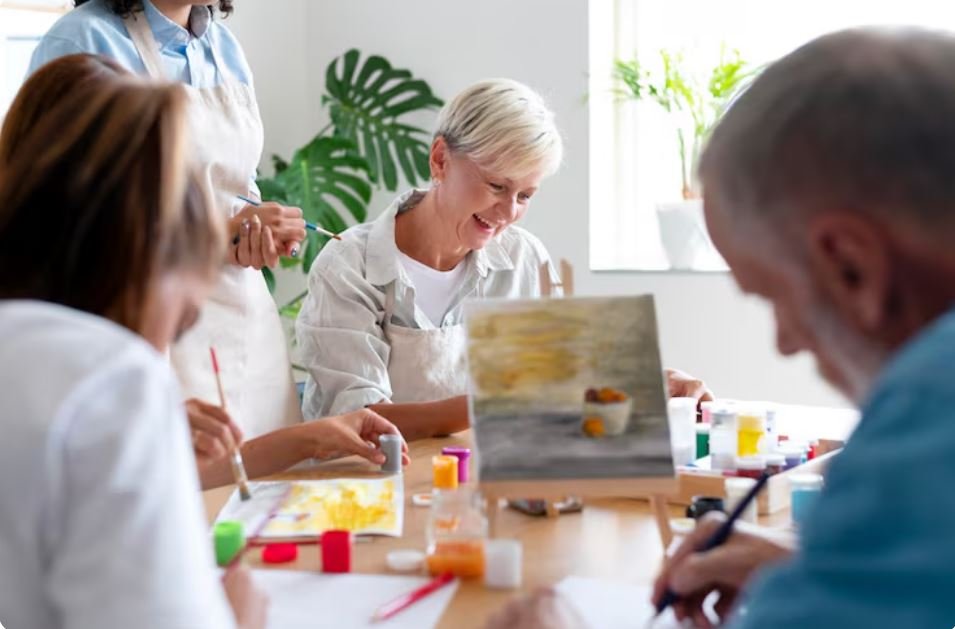
Creative therapy also acts as a social link in many rehabilitation programs. Collective healing is promoted by group projects in which participants co-create sculptures or murals. For instance, the Combat Stress project involves veterans creating symbolic art installations that stand for solidarity, trust, and mutual strength. These cooperative initiatives not only help people recover, but also communities that have been shattered by the unseen effects of war.
In the US, the National Endowment for the Arts has been instrumental in increasing access to creative therapies. Through collaboration with local organizations and military hospitals, they have funded workshops in which civilians and veterans work together to create. Because they emphasize both recovery and reintegration—assisting survivors in reestablishing relationships and rediscovering their purpose via creation—these programs are especially creative.
The movement has also received the support of celebrities. Prince Harry’s involvement with the Invictus Games emphasizes that “healing comes through expression” and emphasizes the importance of creative rehabilitation for injured soldiers. Actor Shia LaBeouf has openly acknowledged that art-based therapy assisted him in facing his own trauma, and Lady Gaga’s Born This Way Foundation provides funding for expressive art programs for young trauma survivors. Because of their advocacy, the discussion about creative healing has become more inclusive and visible, demonstrating that resilience is both a process and an art.
Combat Stress’s adaptive therapy model offers one particularly encouraging example, where veterans document their healing through art. Their works of art—paintings, clay figures, even poetry—become “living documents” that are used as reflective tools in subsequent therapy sessions. This strategy has significantly increased participation and decreased dropout rates, demonstrating that art therapy’s effects go beyond short-term alleviation to long-term change.
Art therapy is now widely used outside of clinical settings. Children in Ukraine turn trauma into symbols of perseverance by painting sunflowers over the debris of bombed schools. Community murals in Rwanda honor peace and remembering. Healing doesn’t have to take place in a physical studio; even in digital spaces, virtual art sessions bring together displaced survivors from different continents. These illustrations demonstrate how creativity can be profoundly unifying and incredibly versatile.
The holistic effect of art therapy—which heals without requiring explanation—makes it especially novel. Survivors take back control of their stories and direct their own healing. A sculpture becomes a representation of resiliency, and a painting becomes a mirror of emotion. Every creation is a step toward restoring meaning as well as memory.
A wider cultural awakening regarding how societies perceive trauma is also signaled by this trend toward creative rehabilitation. Art therapy promotes transformation through recovery, not the erasure of the past. It poses a profoundly human query: how can something that is broken be beautiful? Every sculpture and canvas contains the answer: survival is an act of creation in and of itself.
Survivors continue to find comfort in color and form across continents, from refugee shelters in Amman to veteran centers in London. Every brushstroke is a dialogue between what has been lost and what can still be created, a testament and a renewal. Rewriting war is the goal of art therapy, not forgetting it. One image at a time, survivors are rebuilding the architecture of hope through creation, not just healing.
